


With testosterone, it’s not just about how much your body produces, it’s about how much your body can actually use. If you understand this then you’ll often be able to get your testosterone back to normal without any testosterone replacement therapy (TRT.)
For this article, it’s good to understand the key players in male sex hormone health:
Total testosterone
Free testostosterone
SHGM
Albumin
Insulin
Cortisol
Prevalence of Hypogonadism By Age Group
I am writing this article because a lot of men end up on testosterone without feeling better. At least 40% end up stopping their testosterone in less than a year because the real problem was something else.
How common or prevalent is male hypogonadism?
Age 30-40 - 2%
40-50 - 4%
50-60 - 8%
60-70 - 16%
70-80 - 24%
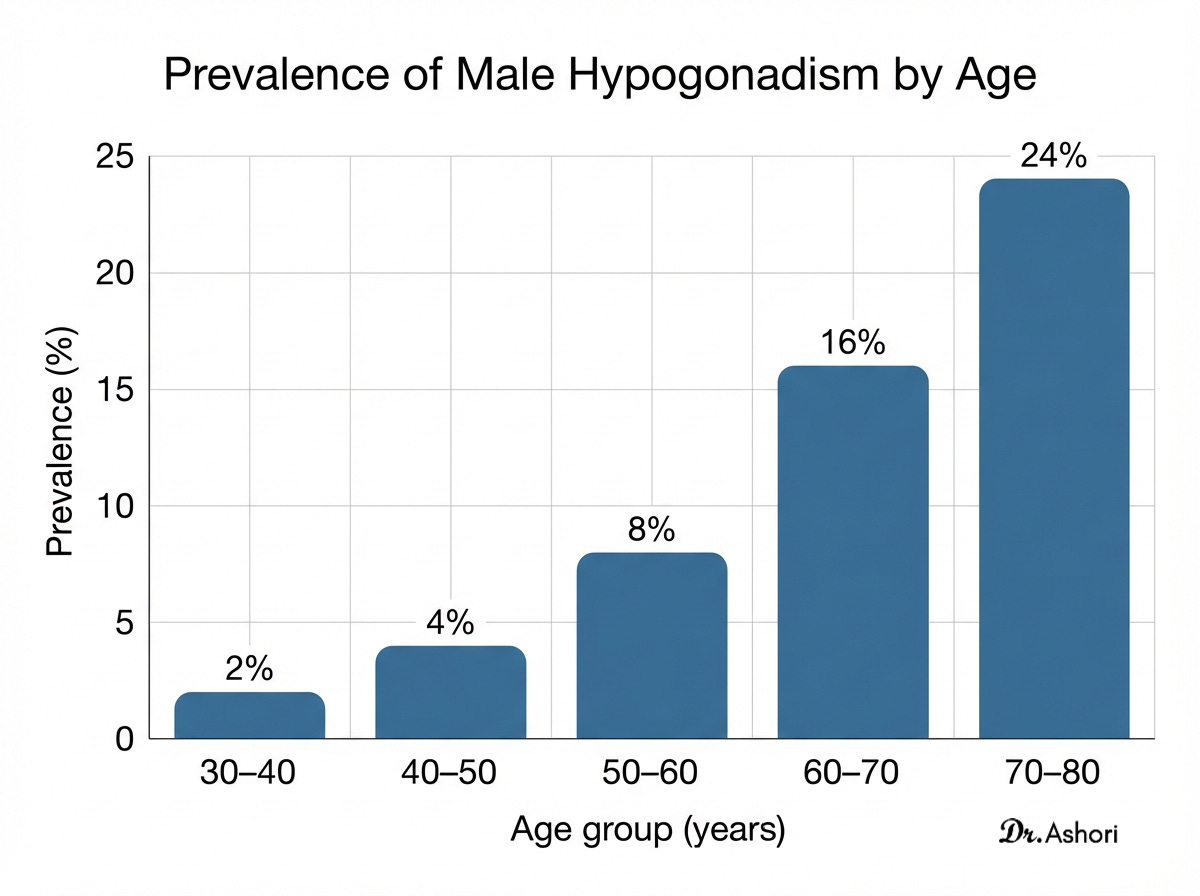
The above numbers capture the men who have low enough testosterone levels that they must take action. Fortunately, the action rarely needs to be TRT.
5 Facts to Understand Your Testosterone After 30
In men, testosterone will naturally decline with age, which is normal. The key is to catch a disease-level low testosterone. If you understand the following 5 facts about testosterone, you’ll get more out of your doctor’s appointment:
#1. The 1% Rule of Decline
The Baltimore Longitudinal Study of Aging and the Massachusetts Male Ain Study showed that normal, healthy men will have a 1% drop per year of their testosterone, starting in mid-life.
That’s a drop of 3 ng/dl per year, independent of obesity, stress, smoking, etc.
Meaning, your testosterone should go down with age. That’s because your body will have a lesser need for it.
#2. Testosterone Availability
As men age, their bodies produce more Sex Hormone Binding Globulin (SHBG), which binds to and reduces the amount of bioavailable and free testosterone in their systems.
Certain health problems will increase this SHGB (that’s a bad thing), which will decrease the free testosterone that can act on various organs:
Increased visceral fat (more estrogen).
Metabolic syndrome (inflammation).
Higher cortisol (more stress).
Sleep apnea.
Medications.
Insulin resistance.
#3. It’s Not Just About Sex Drive
Sex drive is almost always affected when someone has clinically low testosterone (aka, hypogonadism) that requires testosterone replacement therapy.
Here are the other important roles of testosterone in your body:
Muscle mass & strength.
Preserve bone density.
Libido.
Mood stability.
Cognitive function.
#4. How to Accurately Test Your Testosterone
The most accurate way to check testosterone is early morning total testosterone. Ideally, measure 2 separate times.
The most accurate method of measuring total testosterone is the LC-MS/MS (liquid chromatography-tandem mass spectrometry). The more common way it’s measured, which is far less accurate, is through an immunoassay.

For the most accurate free testosterone we prefer the calculated method that requires the measurement of your total testosterone and SHBG. Look for the Vermeulen or TruTT calculation method on the lab test.
Remember, total testosterone is often the “screening test” and free testosterone is often better to decide on whether treatment is needed.
#5. Lifestyle & Testosterone
As mentioned above, when testosterone is low, we’d first look at lifestyle factors before replacing someone’s testosterone.
In descending order, the main causes for low testosterone are:
Obesity.
Metabolic syndrome.
Chronic stress.
Sleep disorders.
Sedentary lifestyle.
If I can decrease your visceral fat, lower your insulin, and drop your cortisol, I’ll lower your SHBG, which will free up more testosterone. You’ll often feel better without any medical interventions.
Disclaimer:
Dr. Mohammad Ashori is a U.S.-trained family medicine physician turned health coach. The content shared here is for education and general guidance only. It is not personal medical advice, diagnosis, or treatment, and it does not create a doctor–patient relationship. Humans are complicated and context matters. Always talk with your own healthcare team before making medical decisions, changing medications, or ignoring symptoms. This information is to help you add more depth to those conversations.